

How Multi-Agent AI Is Catching the 80% of Hacks That Audits Miss
Inside the multi-agent architecture that's detecting zero-days in professionally audited code and reshaping Web3 security

The numbers are stark: $2.9 billion lost to exploits in 2024 alone. But here’s the part that should concern every Web3 builder—approximately 70% of those major hacks occurred in professionally audited contracts.
Traditional audits aren’t failing because auditors aren’t skilled. They’re failing because the attack surface has become too complex for any single methodology to cover completely. And that’s exactly why SavantChat’s recent breakthrough matters.
To put this in perspective: the average cost of a comprehensive smart contract audit ranges from $50,000 to $200,000+ for major protocols. Yet these same protocols are losing hundreds of millions to exploits that slip through. SavantChat’s multi-agent approach offers a complementary layer that dramatically increases coverage without replacing human expertise — at a fraction of the cost.
Try SavantChat for your next security review →
SavantChat made headlines in September 2025 by securing 6th place in a Sherlock audit contest - the first AI to achieve performance on par with expert human auditors in a competitive environment. More importantly, the platform has demonstrated an 80% success rate in identifying zero-day exploits that traditional audits missed, suggesting that many of the catastrophic hacks plaguing the Web3 ecosystem could have been prevented. Lately, SavantChat successfully reproduced Abracadabra and Balancer hacks.
This isn’t about replacing human auditors - it’s about creating a synergy that neither humans nor AI could achieve alone,” explains the vision behind SavantChat’s approach. The platform has garnered endorsements from major players including 1inch, which noted that the multi-agent AI system helps them “secure DeFi with high reliability and much lower costs.
The pattern is clear: teams are falling victim to known vulnerabilities that comprehensive security tooling could have caught. According to Savant’s data, 80% of zero-day exploits submitted to the team were successfully identified and mitigated by SavantChat. This statistic suggests that had these protocols integrated SavantChat into their development workflow, the vast majority of these hacks could have been prevented. What sets SavantChat apart from traditional security tools and even other AI-based solutions is its sophisticated multi-agent architecture. Rather than training a single LLM on known vulnerabilities - an approach that would be limited by historical data - Savant leverages the combined strengths of industry-leading models including OpenAI, Gemini, and Grok.
The platform operates as a sophisticated multi-agent AI system that performs deep security audits, coordinating thousands of parallel LLM calls across specialized models to detect a wide range of vulnerability classes. This approach mirrors how elite security teams operate: multiple specialists examining code from different angles, each bringing unique expertise and perspectives.
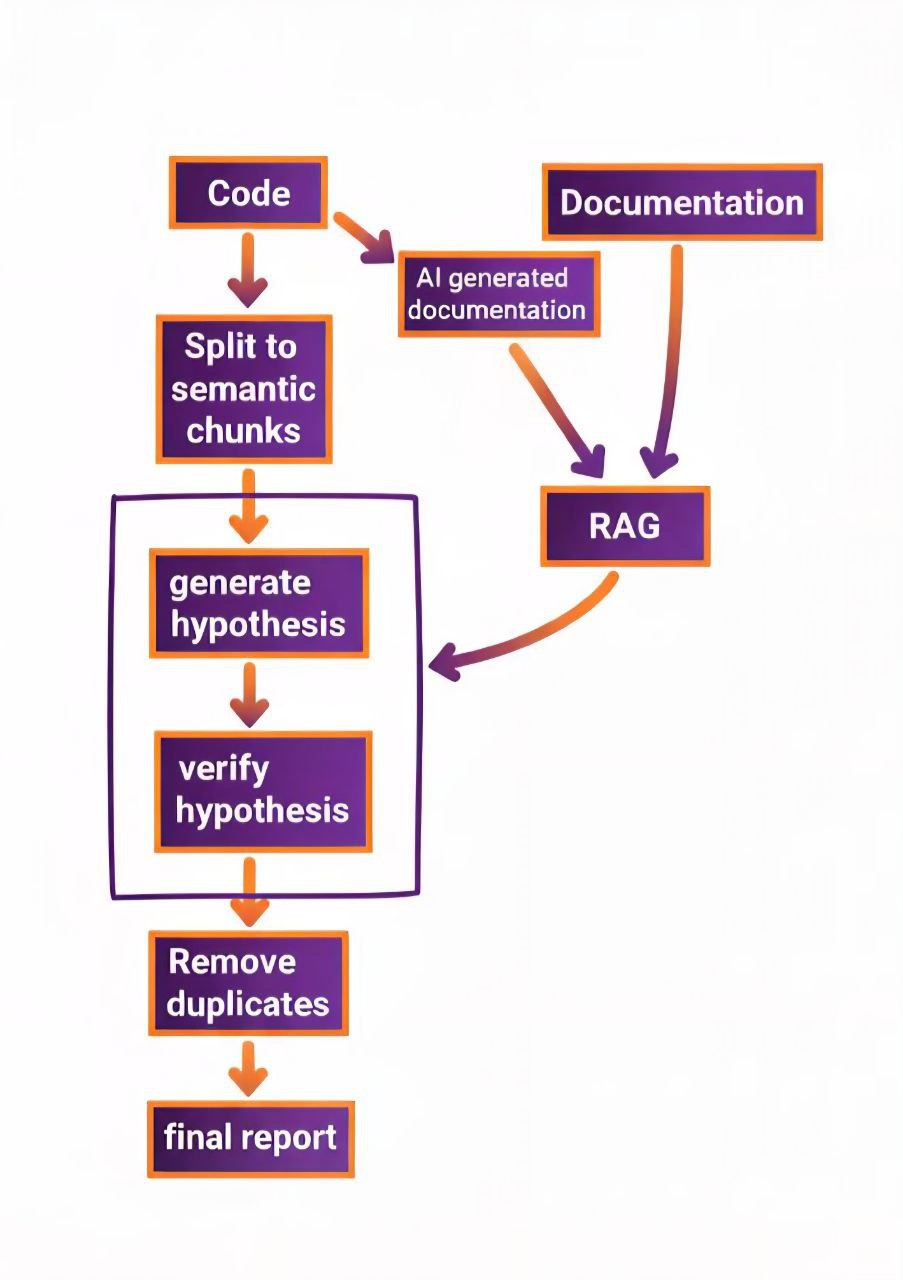
Here is how SavantChat works under the hood.
The multi-agent approach addresses several critical limitations of single-model systems:
Perpetual State-of-the-Art Performance: Every significant LLM release from OpenAI, Google, xAI, or other providers is immediately integrated into Savant’s architecture. When GPT-5 launches, when Gemini evolves, when Grok improves—Savant automatically inherits these advances. This ensures the platform always operates at the cutting edge without requiring complete retraining or architectural overhauls. Each improvement in any underlying model instantly elevates Savant’s detection capabilities.
Fundamentally Different Perspective: Neural networks don’t “read” code the way humans do. They process it as high-dimensional mathematical patterns, detecting subtle statistical anomalies and hidden relationships that human cognition simply cannot perceive. This alien perspective is precisely why Savant finds vulnerabilities that human auditors consistently miss—it’s not looking at the same thing humans see.
Zero Training Lag: Unlike traditional security tools that require extensive retraining on new vulnerability types, Savant benefits instantly from improvements in the underlying models. When OpenAI improves GPT’s code understanding, Savant’s capabilities improve automatically.
The platform’s real-world performance validates its theoretical advantages. Major protocols and security firms have reported significant findings:
One user reported that Savant.Chat “uncovered a critical issue that many seasoned auditors overlooked, proving its ability to boost audit quality”
Another security team noted they “tested savant.chat and were pleasantly surprised! It correctly identified several findings on our test contract and didn’t produce a single clear false positive”
When tested on a real DeFi project of approximately 3,000 lines of code that had already been audited by multiple top firms, Savant successfully surfaced meaningful vulnerabilities post-audit—demonstrating its value as a complementary security layer.
All of these proofs the lack of AI vision on code at the moment. This approach could significantly increase the security level in the industry.
The future of Web3 security isn’t about choosing between human expertise and AI capabilities—it’s about intelligent integration. Savant.chat’s approach offers a blueprint for this future:
Continuous Integration: By integrating with CI/CD pipelines, Savant enables real-time security checks throughout the development process, not just at audit milestones.
Cost-Effective Scaling: While AI generates marginally more noise than average human auditors—measured in multiples rather than orders of magnitude—the cost of AI-powered hypothesis generation is orders of magnitude lower.
Complementary Perspectives: The AI’s unique viewpoint on vulnerabilities, combined with human intuition and contextual understanding, creates a more robust security posture than either could achieve alone.
Democratized Security: By dramatically reducing costs while maintaining high accuracy, Savant makes enterprise-grade security accessible to smaller projects that couldn’t afford traditional comprehensive audits.
Savant.chat’s multi-agent architecture, built on the combined strengths of top-tier AI models rather than a single trained system, offers a glimpse of this future. By providing a complementary perspective to human auditors, catching vulnerabilities that traditional methods miss, and dramatically reducing the cost of comprehensive security analysis, the platform addresses the core challenges facing Web3 security today.
The path forward is clear: embrace the synergy between human insight and AI analysis, integrate security throughout the development lifecycle, and recognize that in the high-stakes world of blockchain, redundancy and multiple perspectives aren’t luxuries—they’re necessities. As the industry continues to evolve, tools like Savant.chat won’t replace the need for security expertise; they’ll make that expertise more effective, more accessible, and ultimately, more successful in protecting the billions of dollars flowing through Web3 protocols.
For projects serious about security, the question is no longer whether to incorporate AI-powered tools like SavantChat, but how quickly they can integrate them to prevent becoming the next casualty in the ongoing Web3 security crisis.
For teams shipping smart contracts in 2025, the calculus is simple: every security layer you skip is a calculated risk with your users’ funds.
The tools exist.
The technology works.
The only question is: will you use them before it’s too late?
Building DNS security tools for Web3?
Seen suspicious domain activity?
Want to share war stories?
Find me at @__Raiders - working on solutions to make this whole mess better.
DNS & Domain Security guide for web3 just got live on SEAL Frameworks, check out.